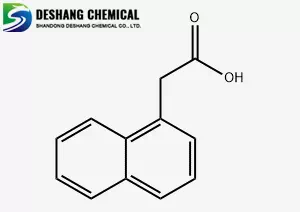
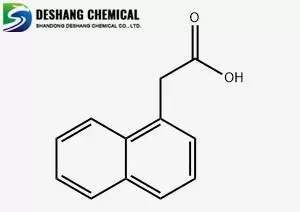
What is 1-Naphthaleneacetic acid CAS 86-87-3?
Pure white crystalline substance, odorless and tasteless, with a melting point of 130℃. It is highly soluble in organic solvents such as acetone, ether, benzene, ethanol and chloroform, and almost insoluble in cold water. At 20℃, its solubility in water is 0.024g/100g. It dissolves in hot water and its salt form has good solubility. The structure is stable and has good storage properties. It is low in toxicity. 80% naphthaleneacetic acid raw powder is a light yellow powder, with a melting point of 106-120℃, moisture content ≤ 5%, stored at room temperature, the content of the active ingredient does not change much. Naphthaleneacetic acid can form salts when encountering alkali, and the salts can dissolve in water. Therefore, when preparing the solution, the raw powder is usually dissolved in ammonia water and then diluted for use. The acute oral LD50 of mice is 1456 milligrams/kilogram (male) and 843 milligrams/kilogram (female). The LC50 (48 hours) of carp is > 40 milligrams/liter. Naphthaleneacetic acid has a stimulating effect on the skin and mucous membranes. Naphthaleneacetic acid can enter the plant through the tender epidermis of leaves, branches, seeds, etc., and be transported along the nutrient flow to the active sites, stimulating cell division and tissue differentiation, inducing monoecious fruiting, forming seedless fruits, and promoting flowering. Within a certain concentration range, it inhibits cellulase enzymes, prevents flower drop, fruit drop and leaf drop. It induces the formation of adventitious roots on branches, accelerates the rooting of cuttings of trees. Low concentrations promote the growth and development of plants, high concentrations cause the generation of endogenous ethylene, thereby having the effect of ripening and increasing yield. It can also improve the cold, drought, flood and salt resistance of certain crops.
1-Naphthaleneacetic acid CAS 86-87-3 Use
Used in organic synthesis, as a plant growth regulator, and used in medicine as the raw material for nasal and eye cleansers and eye-clearing agents.
Used as a plant growth hormone, also for organic synthesis
Broad-spectrum plant growth regulator. It can promote cell division and expansion, induce the formation of adventitious roots, increase fruit setting, prevent fruit drop, and alter the ratio of female and male flowers. Naphthaleneacetic acid can enter the plant through leaves, branch tender epidermis, and seeds, and be transported to the target site along with the nutrient flow. It is commonly used in wheat, rice, cotton, tea, mulberry, tomato, apple, melon, potato, forest trees, etc., and is a good plant growth stimulant. When used to prevent fruit drop, the concentration should not be too high, otherwise it will cause the opposite effect. Because high concentration naphthaleneacetic acid can promote the generation of ethylene in the plant body; when used to promote root growth, it is advisable to mix with indoleacetic acid or other root-promoting agents, because using naphthaleneacetic acid alone, although the root-promoting effect is good, the growth of seedlings is not ideal. When spraying on fruit crops, it is advisable to spray evenly on the leaf surface. For field crops, the general spraying liquid volume is about 7.5kg/100m2, and for fruit trees, it is 11.3 to 19kg/100m2. Treatment concentration: for fruit crops, 10 to 30mg/L for spraying; for wheat, 20mg/L for soaking seeds for 6 to 12 hours; for cotton, 10 to 20mg/L for spraying during the flowering period 2 to 3 times. This product can be mixed with general insecticides, fungicides, and fertilizers. The effect is better when it is sunny and there is no rain.
Naphthaleneacetic acid is a plant growth regulator that promotes the growth of plant roots, and it is also an intermediate of naphthaleneacetamide.
Used in organic synthesis, it is also used as a plant growth regulator and is employed in medicine as the raw material for nasal and eye cleansers and eye-clearing agents.
1-Naphthaleneacetic acid CAS 86-87-3 safety
Category
Pesticide
Toxicity classification
Poisoning
Acute toxicity
Oral - Rat LD50: 1000 milligrams per kilogram;
Oral - Mouse LD50: 743 milligrams
Stimulation data
Eye - Rabbit 100 milligrams - Severe irritation
Storage and transportation characteristics
The warehouse is well-ventilated, kept at a low temperature and dry; food raw materials are stored separately.
Fire extinguishing agents
Dry powder, foam, sand
Service
* Prompt reply and 24 hours online, professional team to provide best price and high quality product.
* Sample testing support.
* Every batch of products will be tested to ensureits quality.
*The packing also can be according the customers` requirment.
*Any inquiries will be replied within 24 hours.
*we provide Commerical Invoice, Packing List, Bill of loading, COA , Health certificate and Origin certificate. If your markets have any special requirements, let us know.