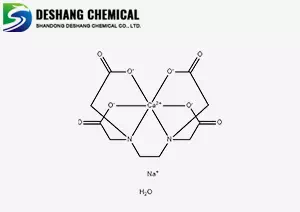
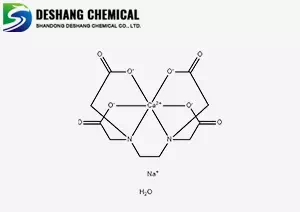
What is Calcium disodium edetate dihydrate CAS 23411-34-9?
Preparation of 0.1 mol/L mercury nitrate solution: Take approximately 35g of mercury nitrate [Hg(NO3)2·H2O], dissolve it in a mixture of 5ml nitric acid and 500ml water, and then dilute it to 1000ml with water. The following method is used for calibration: accurately measure approximately 20ml of this solution, transfer it into a conical flask, add 2ml of nitric acid and 2ml of ammonium ferrous sulfate solution (TS-99). Cool it to below 20℃, and titrate it with 0.1 mol/L thiocyanic acid until a persistent brown color first appears. Calculate the concentration [0Chemicalbook.1 mol/L = 32.46g Hg(NO3)2/L]. Precisely weigh the sample approximately 1.2g, transfer it into a 250ml beaker, add 75ml of water to dissolve it. Add 25ml of dilute acetic acid solution (TS-2) and 1.0ml of diphenylcarbazide solution (TS-91). Slowly titrate with 0.1 mol/L mercury nitrate until a red purple color appears. Each ml of 0.1 mol/L mercury nitrate (preparation method as above) is equivalent to 37.43mg of this product (C10H12CaN2Na2O5).
Calcium disodium edetate dihydrate CAS 23411-34-9 Use
Calcium diethylenetriaminepentaacetate salt - chelating agent; preservative; antioxidant (prevents oxidation by chelation). It has the effect of binding free metals to stabilize product quality.
Calcium diethylenetriaminepentaacetate salt is used to eliminate the inhibition of enzyme catalytic reactions caused by trace heavy metals.
Calcium disodium edetate dihydrate CAS 23411-34-9 safety
ADI: 0 - 2.5 mg/kg (FAO/WHO, 2001). LD50 (10.0 ± 0.74) g/kg (rats, orally). Can be safely used in food (FDA, §172.120, 2000). Excessive consumption can cause vomiting, diarrhea and acute abdominal pain. It has the effect of adsorbing (chelating) trace elements such as Fe, Zn, and Cu in the body.
Service
* Prompt reply and 24 hours online, professional team to provide best price and high quality product.
* Sample testing support.
* Every batch of products will be tested to ensureits quality.
*The packing also can be according the customers` requirment.
*Any inquiries will be replied within 24 hours.
*we provide Commerical Invoice, Packing List, Bill of loading, COA , Health certificate and Origin certificate. If your markets have any special requirements, let us know.