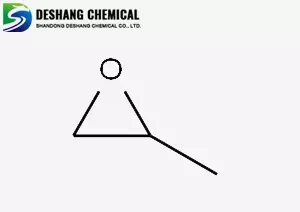
What is Propylene oxide CAS 120-46-7?
Propylene oxide is also known as chloroethylene, 1,2-epoxypropane, oxidized propylene, methyl epoxyethane, and is abbreviated as P.O. It is a colorless, flammable, and volatile liquid with an ether-like odor. Its relative molecular mass is 58.08. The relative density at 25℃ is 0.823. The melting point is -112.13℃. The boiling point is 34.23℃. The refractive index is 1.3664. The flash point is -35℃ (closed cup). The ignition point is 420℃. The vapor pressure (Pa) is: 1.04×10⁴ (-20℃), 2.80×10⁴ (0℃), 6.53×10⁴ (20℃), 7.59×10⁴ (25℃). It is soluble in water (40.5 at 20℃, 60 at 30℃), and is miscible with most common reagents. It forms a binary azeotrope with water (1% by volume) at 39.9℃. It can also form a binary azeotrope with dichloromethane, ether, cyclohexane, cyclopentane, and pentene. The vapor can form an explosive mixture with air, with an explosion limit of 1.9% to 24% (volume fraction). It has optical activity, with a d-body specific rotation of +12.72° (18℃) and an lChemicalbook - body - 8.26° (18℃). The molecule contains a chemically active epoxy group, which can undergo many chemical reactions. The chemical activity is slightly lower than that of ethylene oxide, and it reacts with substances containing active hydrogen (such as water, alcohols, acids, amines) to open rings and form diols, alcohol ethers, alcohol amines, etc. It undergoes hydrolysis reactions, generating propylene glycol. It undergoes etherification reactions, generating alcohol ethers. Under the action of a catalyst, it can form polyether polyols. It reacts with glycerol to form polyether triols. It reacts with carboxylic acids to form esters. It reacts with ammonia to form alcohol amines. It reacts with halogenated hydrogen to form halogenated alcohols. It reacts with hydrogen sulfide to form thiols. It reacts with phenylthiophenol to form hydroxypropyl phenylthi醚. Under the action of trimethylamine catalyst, it reacts with dibenzocyclohexane to form triacylpropylene carbonate. Under the action of a catalyst, it can isomerize to form propanal. Propylene oxide is toxic and has irritancy to the skin and eyes. Even a 1% dilute solution has irritancy. The vapor irritates the respiratory organs and eyes, and has a central nervous system inhibitory effect after inhalation. The oral LD50 of rats is 930mg/kg. The maximum allowable concentration in the workplace is 20×10-6.
Propylene oxide CAS 120-46-7 Use
The important petrochemical raw materials are mainly used for the production of propylene glycol, polyether polyols, polypropylene glycol, propylene glycol ethers, synthetic glycerol, surfactants, foaming agents, demulsifiers and mineral processing agents, etc., and are also used for the manufacture of isopropanolamine, propylene carbonate esters, etc.
Epoxypropylene is an intermediate of the herbicide imazamox and is also an important organic synthetic chemical raw material. It can be used to produce propylene glycol, propylene alcohol, propionaldehyde, isopropylamine, synthetic glycerol, organic acids, etc., and can also be used to prepare non-ionic surfactants, wetting agents, emulsifiers, detergents, etc.
Epoxypolymer is an important organic chemical raw material and ranks as the third largest product of the propylene series. Its primary application is in the production of polyols (polyethers), which are then used to manufacture polyurethanes. In the usage distribution in the United States and Western Europe, this application accounts for over 60% and 70% respectively. Epoxypolymer is used to produce nonionic surface-active agents, propylene alcohol, propylene glycol, isopropanolamine, propionaldehyde, synthetic glycerol, organic acids, synthetic resins, foam plastics, plasticizers, emulsifiers, wetting agents, detergents, disinfectants, fumigants, etc. The fine chemicals derived from epoxypolymer are almost applied in all industrial sectors and daily life.
Propylene oxide CAS 120-46-7 safety
The toxicity of propylene oxide is less than that of ethylene oxide. It mainly causes irritation, along with mild anesthesia and protoplasmic toxicity. Direct contact can stimulate the skin, and in severe cases, it can lead to skin necrosis. The olfactory threshold is 360mg/m3. After inhaling high concentrations, poisoning can occur within a few minutes, presenting symptoms such as eye and upper respiratory tract irritation, breathing difficulties, severe headache, dizziness, weakness, calf muscle spasms, unsteady gait, nausea, vomiting, and diarrhea. Severe cases may also exhibit restlessness, delirium, and coma. The course of the disease can involve elevated blood pressure, arrhythmias, myocardial damage, gastrointestinal bleeding, toxic intestinal paralysis, and liver and kidney damage, etc. Since the toxic symptoms may be related to the increase of histamine and other bioactive substances in the body, antihistamine drugs and sodium thiosulfate can be used for treatment. The threshold value of propylene oxide in the workshop air is currently set at 240mg/m3 (TLV-TWA, USA, 1980), and the maximum allowable concentration is 1mg/m3 (UK, 1972).
Service
* Prompt reply and 24 hours online, professional team to provide best price and high quality product.
* Sample testing support.
* Every batch of products will be tested to ensureits quality.
*The packing also can be according the customers` requirment.
*Any inquiries will be replied within 24 hours.
*we provide Commerical Invoice, Packing List, Bill of loading, COA , Health certificate and Origin certificate. If your markets have any special requirements, let us know.