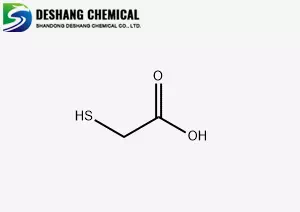
What is Thioglycolic acid CAS 68-11-1?
Purification method
The industrial production methods of mercaptoacetic acid include sodium hydrosulfide method, sodium thiosulfate method, and sodium polysulfide method, etc. All these methods require the separation and extraction of mercaptoacetic acid from the aqueous solution of mercaptoacetic acid. The main components of the aqueous solution of mercaptoacetic acid are 9.0% - 11.0% mercaptoacetic acid, 20% - 24.0% sodium chloride and water. The specific steps of separation are as follows:
(1) The mercaptoacetic acid aqueous solution is first concentrated and dehydrated by vacuum distillation;
(2) The concentrated solution obtained in step (1) is filtered to separate out the solid sodium chloride;
(3) The filtrate obtained in step (2) is concentrated again, and the concentrated liquid is filtered;
(4) The solid sodium chloride obtained in steps (2) and (3) are combined and washed to recover the mercaptoacetic acid carried by Chemicalbook;
(5) The concentrated liquid of mercaptoacetic acid obtained in step (3) is added with a stabilizer and subjected to vacuum distillation to separate out the finished mercaptoacetic acid product.
Chemical properties
Pure mercaptoacetic acid is a colorless transparent liquid, while the industrial product is colorless to slightly yellow in color and has a strong irritating odor. It can be miscible with water, ethanol, and ether. Hair straightening products utilize the fact that mercaptoacetic acid breaks some disulfide bonds in the hair to change the curvature of the hair, achieving the effects of hair straightening and beautification. However, mercaptoacetic acid is toxic and can be absorbed through the skin and respiratory tract, causing symptoms such as skin damage and allergic reactions, and even affecting the body's metabolism. Long-term exposure can cause damage to various tissues and organs, and it has strong mutagenicity and reproductive toxicity. Therefore, strict control is required for it.
Thioglycolic acid CAS 68-11-1 Use
Thioacetic acid (TGA) is mainly used as a finishing agent for blankets and a raw material for cold bleaching solutions. TGA possesses both the reaction characteristics of a carboxylic acid and those of a mercapto group. The most important reaction is the one with disulfides. Especially under alkaline conditions, it reacts with cysteine in hair, breaking the (-S-S-) bond of cysteine and generating a semi-cysteine acid that is easy to curl. It is mainly used as a curling agent, depilatory agent, low-toxic or non-toxic stabilizer for polyvinyl chloride, initiator for polymerization reactions, accelerator, chain transfer agent, and metal surface treatment agent. In addition, thioacetic acid is a sensitive reagent for detecting iron, molybdenum, aluminum, and tin; it can also be used as a nucleating agent for crystallization during the processing of polypropylene, a modifying agent for coatings and fibers, and a finishing agent for blankets.
It produces intermediates for various pharmaceuticals such as thiopropionitrile (Captopril), biotin, zinc sulfide acid, and sodium disulfide dithiobenzoic acid. It is also an important raw material for synthesizing cysteine, hormone agents, industrial disinfectants, and synthetic sulfuric acid.
Mercaptoacetic acid is not only used as an intermediate for cefivitril, but is also widely used as a hair curling agent, depilatory agent, low-toxic or non-toxic stabilizer for PVC, metal surface treatment agent, and initiator, accelerator and chain transfer agent for polymerization reactions.
Sensitive reagents for iron, molybdenum, silver and tin. Their ammonium and sodium salts are used as hair straightening agents for curling, while the calcium salts are used as depilatory agents.
Thioglycolic acid CAS 68-11-1 safety
Corrosive substances
High toxicity
Oral administration - LD50 for rats: 114 milligrams per kilogram; Oral administration - LD50 for mice: 242 milligrams per kilogram
Skin - 3% of the human body
Flammable; Burning produces toxic sulfur oxide smoke
Service
* Prompt reply and 24 hours online, professional team to provide best price and high quality product.
* Sample testing support.
* Every batch of products will be tested to ensureits quality.
*The packing also can be according the customers` requirment.
*Any inquiries will be replied within 24 hours.
*we provide Commerical Invoice, Packing List, Bill of loading, COA , Health certificate and Origin certificate. If your markets have any special requirements, let us know.